Consent agenda: what it is and how to use one
A consent agenda groups the routine, non-controversial items of a board meeting, like last meeting’s minutes and written reports, into one item that the board approves all at once, usually without debate. Members read the items before the meeting. If anyone wants to discuss one, it comes off the consent agenda and is taken up separately. The time saved goes to the items that need a real discussion and a decision.
Public bodies such as city councils use them, and the same approach works for nonprofit and HOA boards. Robert’s Rules of Order Newly Revised covers the practice under the name “consent calendar” (12th edition, 41:32). Your bylaws and any law that applies to your board come first; this page is general guidance, not legal advice.
What goes on a consent agenda
Items the board has to approve but doesn’t need to talk about. Montana’s Department of Natural Resources and Conservation, in its guide for conservation district boards, lists the typical ones:
- Minutes of the previous board meeting
- Committee minutes
- The administrator’s or executive director’s written report
- Other information the board only needs to review
You can also add routine items that were already reviewed elsewhere, such as a contract renewal at the same price, as long as nobody is likely to want to discuss them.
What doesn’t belong: anything a member is likely to question, anything that changes policy, and items that need a real decision. If you’re not sure whether an item is routine, leave it off.
The Montana guide adds a rule of its own for conservation district boards: financial statements for review and board approval are not part of a consent agenda. That’s that guide’s rule, not a general one. Other boards follow their own bylaws and rules of procedure to sort reports into those the board only reviews or receives and those it has to approve, and only the routine ones go on the consent agenda.
How it works in the meeting
- Send everything ahead. The consent agenda only works if members have read the items. Send the full packet with the agenda, not the morning of the meeting.
- The chair asks if anyone wants an item removed. “Does anyone wish to remove an item from the consent agenda?”
- Removed items are set aside. On Washington city councils, Washington’s Municipal Research and Services Center (MRSC) explains, any councilmember can move to remove an item for separate consideration, and the council then votes on the rest without it. Removed items are discussed after the consent agenda, or at a later meeting.
- The chair takes approval. Montana’s guide gives the wording: “If there are no objections, these items will be adopted.” After a pause: “As there are no objections, the consent agenda items are adopted.” A show of hands isn’t needed. Some boards take a single voice vote instead.
- Move on to the regular agenda, starting with any items that were removed.
Here’s the short version as a script:
Chair: Item 3 is the consent agenda: the March 12 minutes, the finance committee minutes and the executive director’s report. Does anyone wish to remove an item? Director Lee: I’d like to pull the executive director’s report. I have a question about the volunteer numbers. Chair: The report is removed and will be taken up as item 4. Are there any objections to adopting the remaining consent agenda items? (Pause.) Hearing none, the consent agenda is adopted.
An example consent agenda
Riverbend Food Pantry board meeting, April 9, 2026

1. Call to order
2. Approval of the agenda
3. Consent agenda
   a. Minutes of the March 12 board meeting
   b. Minutes of the March 26 finance committee meeting
   c. Executive director's report (written, in the packet)
   d. Renewal of the walk-in cooler service contract, same terms and price as 2025
4. Items removed from the consent agenda (if any)
5. Q1 financial statements (for review)
6. Decision: open a second distribution day on Saturdays?
7. Adjournment
The financial statements and the Saturday decision sit on the regular agenda, where they get time for questions. Build your own with the board meeting agenda template.
Setting one up
How a board starts using a consent agenda depends on its bylaws and rules of procedure. For Washington cities, MRSC notes that setting up a consent agenda system usually requires council action first, such as an ordinance or resolution. A public body should also check its state’s open meetings law and its own rules of procedure.
Recording it in the minutes
The Montana guide says the items approved on the consent agenda must be recorded in the minutes, and the documents themselves archived with the complete meeting record. So a reader can tell exactly what one approval covered, the entry should do three things:
- List every item that was approved, not just “consent agenda approved”.
- Say how it was adopted: by unanimous consent, as in Montana’s guide, or on a motion and a vote.
- Say what happened to any item that was removed: taken up later in the meeting, or held over to a later one.
The board meeting minutes template has a place for this.
Sample minutes with a consent agenda
Three boards that publish their minutes, each recording its consent agenda a different way: a public conservation district that votes on a motion, a charter school board that removed an item first, and a nonprofit board that adopts resolutions by general consent. The images show only the consent agenda part of each set of minutes. Open the original to read it in full.
A motion and a vote: Thurston Conservation District
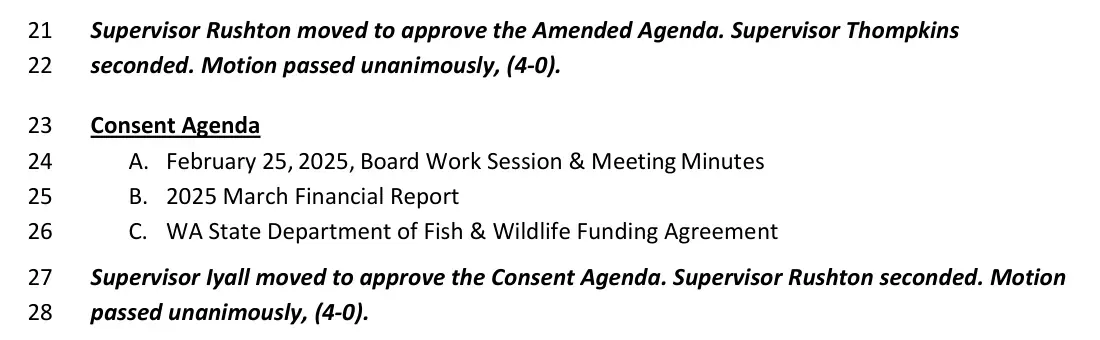
“Supervisor Iyall moved to approve the Consent Agenda. Supervisor Rushton seconded. Motion passed unanimously, (4-0).”
What it does well
- Lists each item under the Consent Agenda heading, lettered A to C, so the minutes alone show what the one vote approved: last month’s minutes, the March financial report and a state funding agreement.
- Records who moved and seconded the approval and the count, and repeats the motion in a “Summary of Motions Passed” at the top of the minutes, where a reader looking for decisions finds it first.
Worth doing differently
- The funding agreement is named only by the agency it is with. An amount or an agreement number would let a reader find the exact document later.
Removing an item first: IDEA Greater Cincinnati
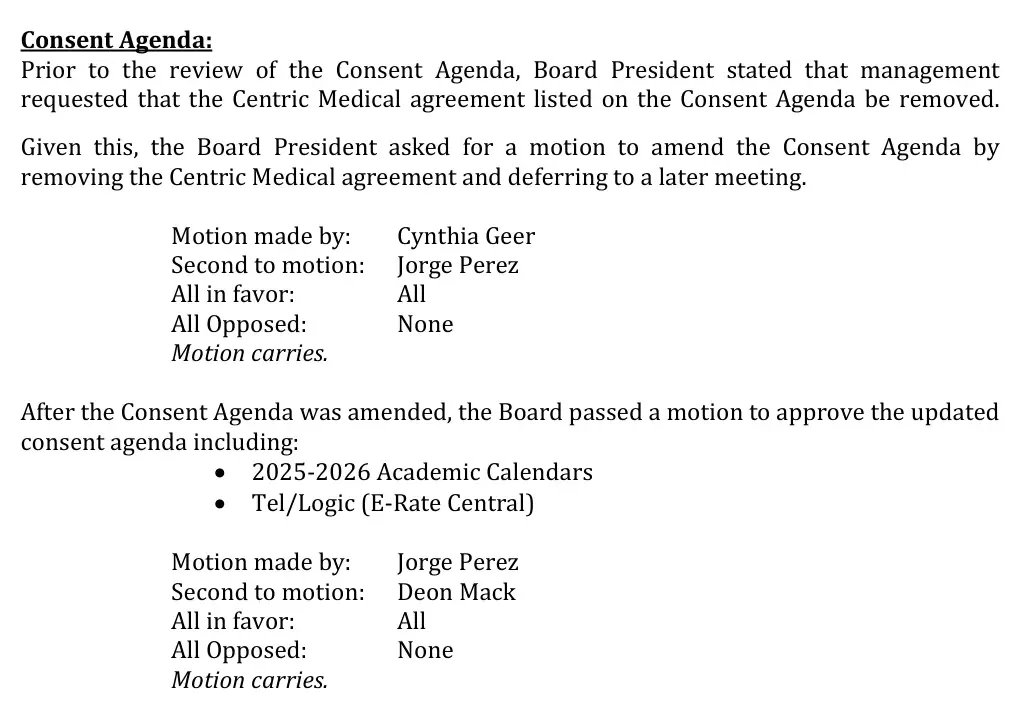
“the Board President asked for a motion to amend the Consent Agenda by removing the Centric Medical agreement and deferring to a later meeting.”
What it does well
- Says who asked for the removal (management, through the board president), which item came off, and what happens to it: it is deferred to a later meeting.
- Records the removal and the approval of what was left as two separate motions, each with its mover and seconder, and names the items that were approved.
Worth doing differently
- “Approve the updated consent agenda including” leaves a reader unsure whether the two items listed were the whole consent agenda. “Consisting of” says it plainly.
- Both votes are recorded as “All” in favor. One voting director was absent, so writing down the count saves the reader from checking the attendance list.
Resolutions by general consent: ICANN
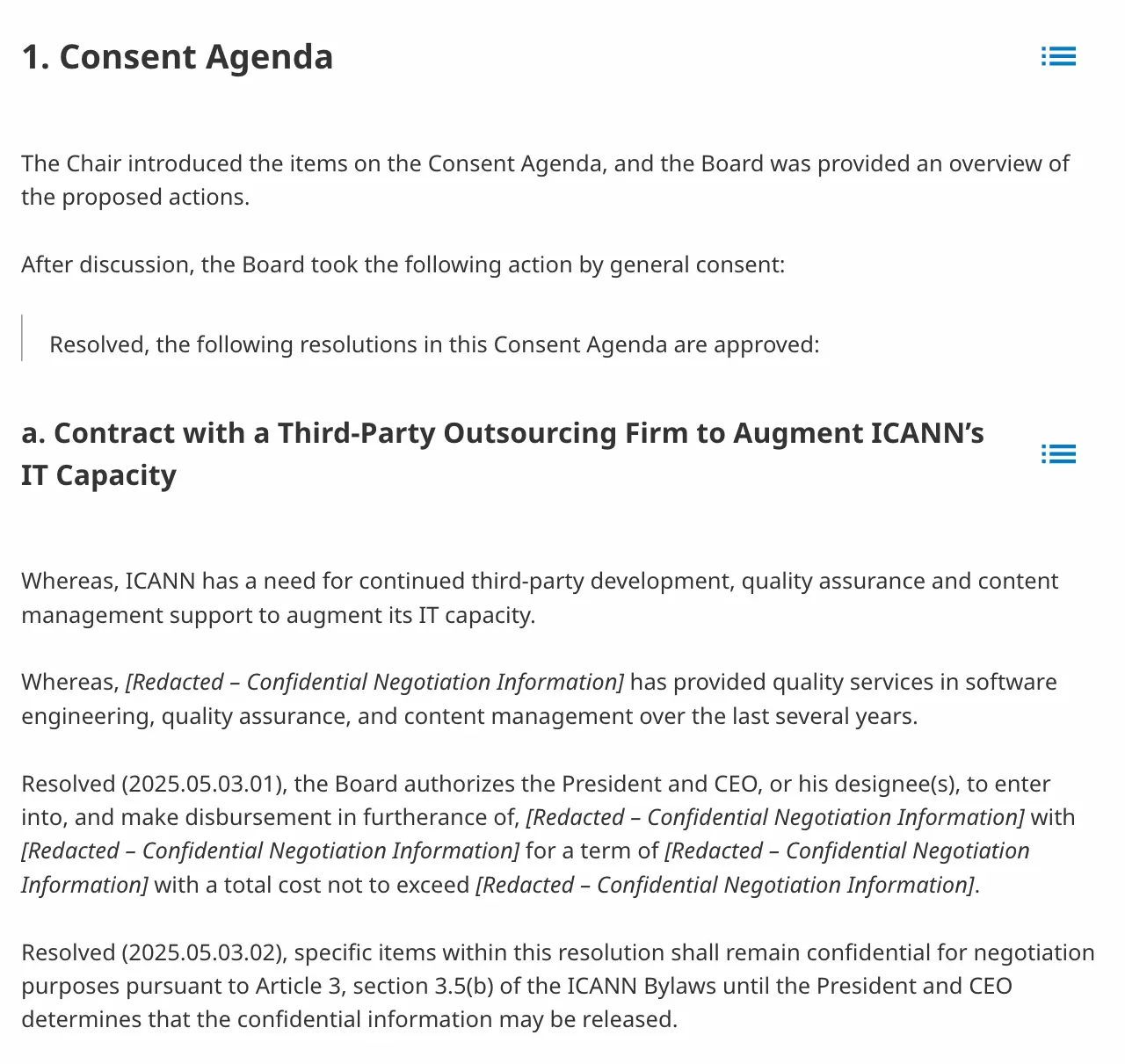
“Resolved, the following resolutions in this Consent Agenda are approved”
What it does well
- One resolution adopts the whole consent agenda, and each item keeps its own resolution number (2025.05.03.01 and 2025.05.03.02), so anyone can cite the exact decision later.
- The minutes say the board acted “by general consent”, with no separate vote count, and record that all members voted in favor.
- Each item keeps its rationale in the minutes. Here that includes who recommended the contract (the ICANN organization and the Board Finance Committee) and that its cost was already in the FY26 budget.
- Where the terms are confidential, the minutes say so, cite the bylaw that allows it (Article 3, section 3.5(b)), and say who decides when the terms are released.
Worth doing differently
- A contract with a cost is a judgment call for a consent agenda. This one came with a finance committee recommendation and was already budgeted, and the minutes say so. Without that kind of review beforehand, put a contract on the regular agenda.
Copy the entry for your minutes
Built from what the three examples do well. Fill in the parts in brackets and delete the lines you don’t need.
[Item number]. Consent agenda
[Name] asked that [item] be removed from the consent agenda. It will be taken up as item [number] / It is deferred to the [date] meeting.
The remaining consent agenda items were adopted [by unanimous consent / on a motion by (name), seconded by (name), (for) to (against)]:
a. Minutes of the [date] board meeting
b. [Item, with its amount or document number]
c. [Item, with its amount or document number]
The documents are filed with these minutes.Common mistakes
- Hiding decisions in it. A large purchase or a policy change on the consent agenda looks like an attempt to avoid discussion, even when it isn’t one. Put it on the regular agenda.
- Not sending the packet in time. If members haven’t read the items, they’ll either pull everything or approve things they haven’t seen.
- Arguing with a request to remove an item. Where any member can remove an item, as MRSC describes for Washington city councils, one request is enough. Take the item off and deal with it on the regular agenda.
- Minutes that just say “consent agenda approved.” List the items, so the minutes stand on their own.
FAQ
Does a consent agenda need a motion and a vote?
Not always. The chair can ask whether there’s any objection and, if there’s none, declare the items adopted. That’s the approach in Montana’s guide. Some boards prefer a motion and a single voice vote. Either way, the result goes in the minutes.
Can one member take an item off the consent agenda?
On many boards, yes. MRSC describes it this way for Washington city councils: any councilmember can move to remove an item for separate consideration. Check your own rules, since some boards spell out the process.
Is the consent agenda the same as “approving the agenda”?
No. Approving the agenda sets the order of business for the meeting. The consent agenda is one item on that agenda, and adopting it approves the items it contains.
Sources
- Montana Department of Natural Resources and Conservation, Conservation Districts Bureau, “How to Use a Consent Agenda”: what a consent agenda includes, removing items for discussion, the chair’s wording, recording approved items in the minutes, and that, for conservation district boards, financial statements for review and approval are not part of it.
- Municipal Research and Services Center (MRSC), “Agendas: Consent Agendas”, last modified August 13, 2025: grouping routine items into a single motion, any councilmember can move to remove an item, and setting up the system usually requires council action. MRSC provides guidance to local governments in Washington State under chapter 43.110 RCW.
- Robert’s Rules of Order Newly Revised, 12th ed. (2020), 41:32 (consent calendar). The book is not online; see the official Robert’s Rules site.